
Indian deeptech startups are facing a brutal reality in 2026.
Spend time in Bengaluru’s deeptech labs, Hyderabad’s hardware clusters, or Delhi’s founder circles, and the same pattern keeps showing up.
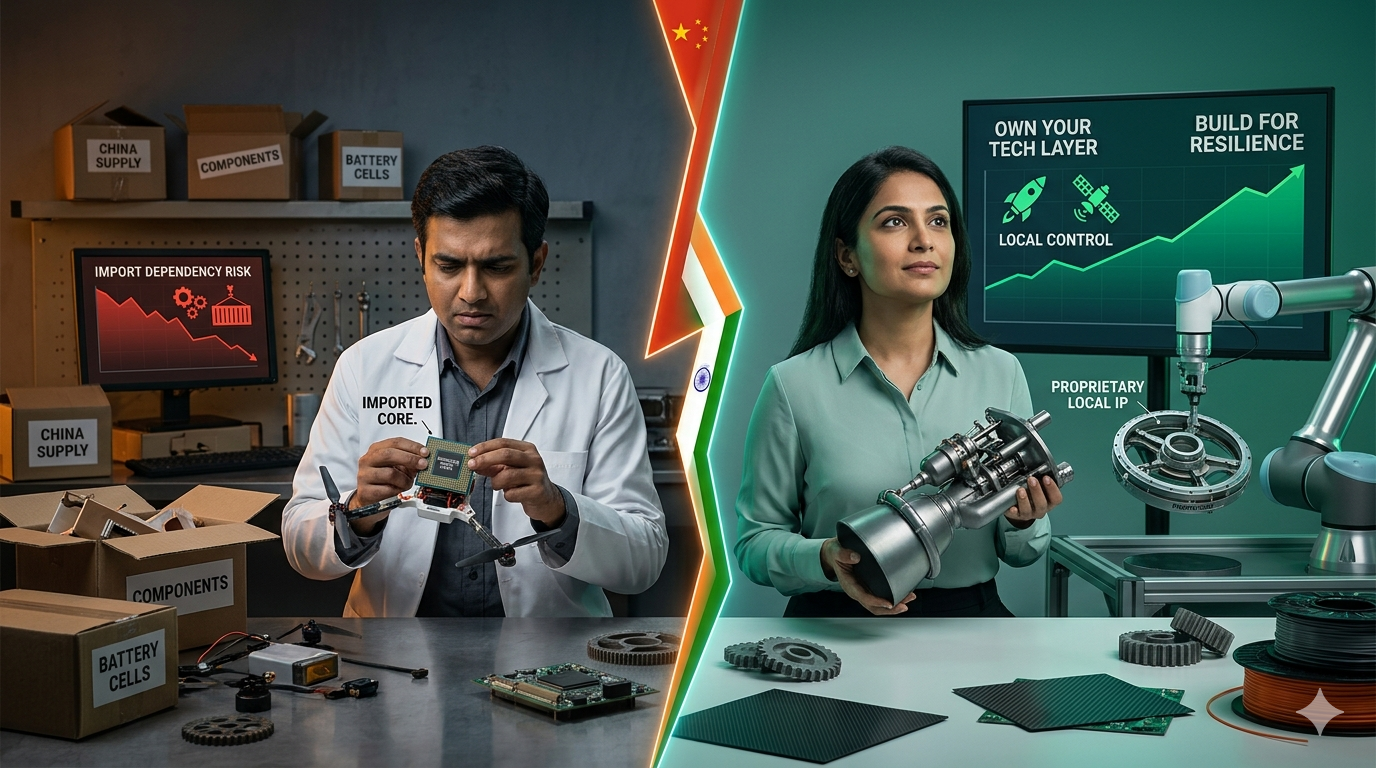
A startup raises funding. Builds prototypes. Imports key components from China — batteries, semiconductors, precision parts — to move fast.
The product works.
Until it doesn’t.
Prices drop. Margins collapse. Supply becomes unpredictable. Customers switch. What looked like innovation turns into a survival fight.
This isn’t bad luck.
It’s a structural problem — and it explains why many Indian deeptech startups are losing to China imports in 2026.
Why Indian Deeptech Startups Depend on China Imports
Most Indian deeptech startups today rely heavily on China for critical components:
- Battery cells
- Semiconductors
- Electronics modules
- Manufacturing equipment
This approach works early on.
But it creates a dangerous dependency:
You don’t control your costs.
You don’t control your supply.
You don’t control your long-term survival.
Why This Model Feels Smart in the Beginning
For founders, importing from China looks like the fastest path to market:
- Faster prototyping
- Lower upfront investment
- Access to proven global supply chains
- Easier investor storytelling
Instead of spending years building local manufacturing capability, startups assemble and launch quickly.
Investors like it. Timelines shrink. Products ship faster.
But this speed hides a major weakness.
When China Scales, Indian Startups Lose Pricing Power
The moment Chinese manufacturers scale further:
- Prices drop significantly
- Quality becomes “good enough”
- Supply chains become strategic weapons
Indian startups depending on imports lose their edge instantly.
And if disruptions hit — delays, export restrictions, cost spikes — the entire business model starts collapsing.
Case Study: Log9 Materials and the Deeptech Trap
Log9 Materials was one of India’s most talked-about EV battery startups.
- Raised significant funding
- Attempted local manufacturing
- Focused on alternative battery technologies
But faced major challenges:
- Chinese LFP battery prices remained extremely competitive
- Local production struggled to match cost efficiency
- Operational and performance issues emerged
- Financial pressure increased rapidly
By 2025, the company entered insolvency proceedings.
This wasn’t just a company-level failure.
It exposed a deeper issue across Indian deeptech startups:
Delayed localisation in a market dominated by global manufacturing scale.
The Structural Disadvantage India Faces
India remains heavily dependent on imports for:
- Semiconductors
- Advanced battery materials
- Precision manufacturing tools
At the same time, Indian conditions are tougher:
- Extreme heat and dust
- Highly price-sensitive customers
- Infrastructure variability
This creates a difficult equation:
Compete globally on cost while surviving locally on constraints.
The Founders Who Are Winning in 2026
The smartest Indian deeptech founders are not avoiding imports entirely.
They are choosing where to depend — and where to build control.
Skyroot Aerospace
- Built proprietary propulsion systems
- Focused on local integration
- Optimised for Indian cost structures
Agnikul Cosmos
- Developed in-house 3D-printed rocket engines
- Built custom launch systems
- Reduced critical external dependency
Defence and Robotics Startups
- Invest in local IP and certifications
- Align with government procurement
- Prioritise supply-chain resilience
What These Startups Did Differently
- Owned critical technology layers
- Adapted to Indian operating conditions
- Built long-term supply chain resilience
That’s the difference between assembling a product and building a defensible system.
Why This Problem Is Getting Worse in 2026
1. China’s Manufacturing Scale Keeps Prices Low
Massive production capacity continues to push global component prices down.
2. India Is Pushing Localisation
Policies and incentives increasingly favour domestic manufacturing and deeptech capability.
3. Deeptech Needs Long-Term Thinking
Recent policy changes reward long-term, capital-intensive innovation instead of quick assembly models.
4. Buyers Now Care About Supply Chain Security
Enterprises and government buyers prefer stable, local supply chains over import dependency.
The Hidden Cost of Import Dependency
Import reliance doesn’t just hurt margins.
It changes how founders think.
Instead of asking:
What problem should we solve for India?
They start asking:
How fast can we build this using existing parts?
That shift quietly kills innovation.
As Indian deeptech startups grapple with intense competition from Chinese imports in 2026, the necessity for sustained innovation and a focus on domestic manufacturing becomes paramount. To thrive, these startups must prioritize long-term strategies that foster supply chain security and capitalize on the evolving policies that promote deeptech capabilities.
1. Focus on India-Specific Problems
Design for real constraints like cost, climate, and infrastructure.
2. Control Critical Technology Layers
Own the part of the stack that defines your advantage.
3. Build for Price Pressure
Assume global prices will drop — and plan for it.
4. Use Government Policy Strategically
Leverage incentives, funding, and localisation support for long-term growth.
The Bottom Line
China’s manufacturing advantage isn’t going away.
But building a startup fully dependent on it — without local depth — is becoming unsustainable.
The founders who win in 2026 will not be the fastest builders.
They will be the ones who:
- Control critical layers
- Understand Indian realities
- Build for resilience, not just speed
In deeptech, you don’t win by assembling faster.
You win by controlling what matters.
FAQs
Why do Indian deeptech startups rely on China imports?
Because China offers lower costs, faster supply chains, and mature manufacturing ecosystems that India is still developing.
Can Indian startups compete with Chinese manufacturing?
Yes, but only by building local capabilities, owning key technology layers, and adapting to Indian conditions.
What is the biggest risk of import dependency?
Loss of pricing power and vulnerability to supply chain disruptions.
Is localisation necessary for deeptech success in India?
In most cases, yes. Without localisation, startups struggle to compete on cost and resilience.
Read more insights on VentureBrief to understand what’s really happening inside India’s startup ecosystem.